

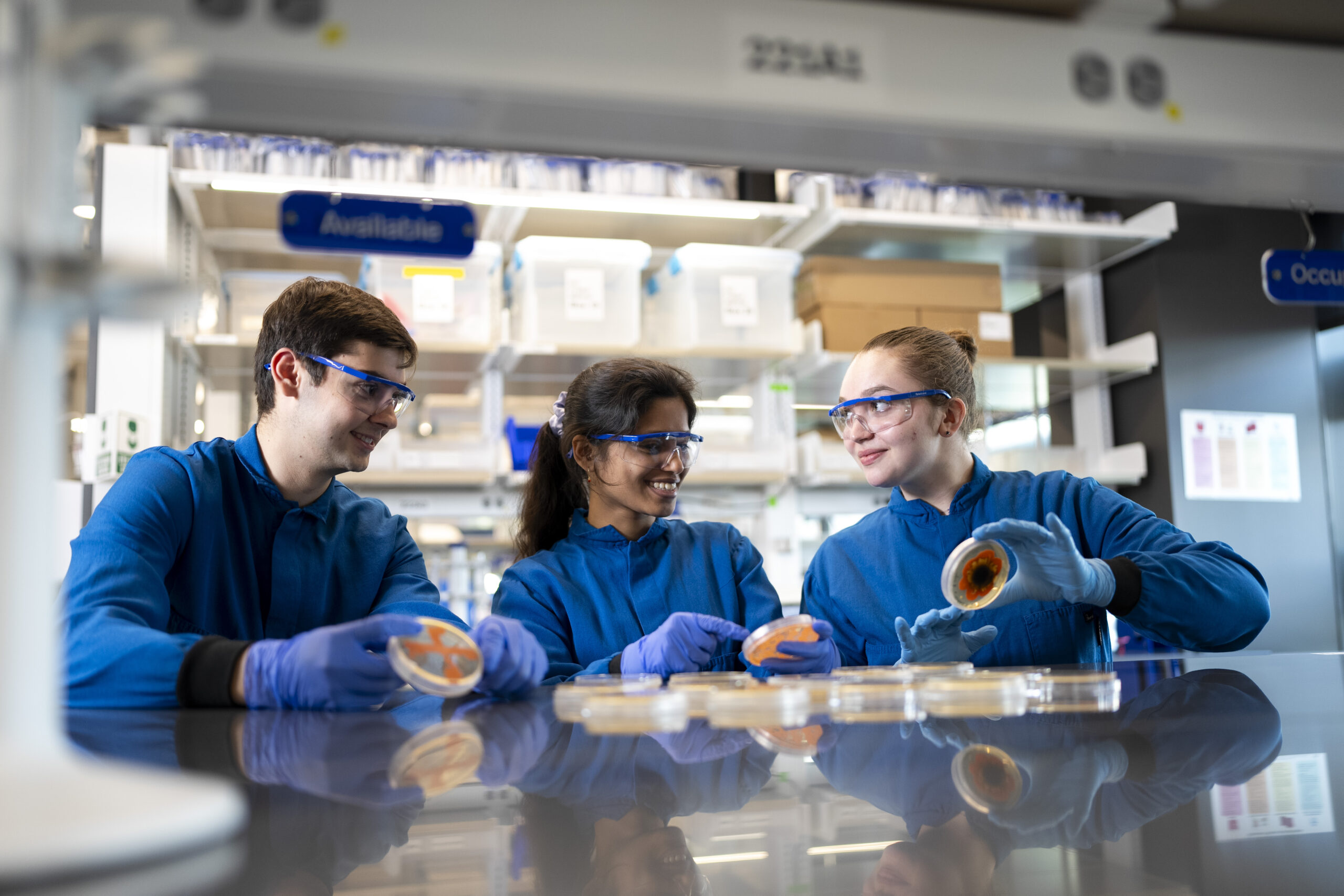
Cloning Fluorescent Plasmids
The Wet Lab Makerspace invites you to enjoy our inaugural Community Project! These projects are open enrollment opportunities to practice laboratory skills. The makerspace provides materials, protocols, instruction, and support to guide you as you through foundational workflows in the biological and chemical sciences. By completing these non-credit courses, students can earn digital badges, demonstrating their mastery of core skills.
In Spring 2026, our Community Project will be Cloning Fluorescent Plasmids, which will introduce molecular cloning via Gibson assembly. Students will have the opportunity to cultivate bacteria and perform DNA extraction, PCR, gel electrophoresis, Gibson assembly, and colony PCR, with the objective of cloning a gene encoding a fluorescent protein into a plasmid backbone and transforming that plasmid into E. coli.
Schedule
Pacing
With the exception of Week 1, which must be attended in-person, students will have the option of completing each week’s protocols either in in-person workshops or independently in the makerspace. Each week’s workshop will be scheduled on multiple days and times to accommodate a range of student schedules. Regardless of whether you attend in-person instruction or work independently, project TAs will be available to answer questions.
Students will have the opportunity to earn three badges:
Fill out this form to enroll!
Instruction begins on Monday 2 February!
Enrollment will be capped at 100 students. We look forward to seeing you all for an exciting semester of science!